

 Unter
Unter Innovative Kühllösungen: Ferverets Weg von Kernreaktoren zur Effizienzsteigerung durch KI
The growth of artificial intelligence hinges upon the dramatic rise of data centers, making their energy consumption a key consideration. By the close of this decade, data centers are predicted to account for 9 to 17 percent of the entirety of U.S. electricity consumption. Around one-third of this consumption is attributed to cooling the chips that drive AI models, a component crucial to the functioning of AI.
Towards More Efficient Cooling
Enter Ferveret, a start-up by Reza Azizian and Matteo Bucci, both with prior experience in nuclear engineering at MIT. Azizian, once an MIT postdoc, and Bucci, an associate professor at MIT, are pioneering an innovative cooling system that takes a leaf out of nuclear reactor techniques. Their approach aims to overhaul the traditional cooling process, reducing reliance on water and significantly curbing electricity usage.
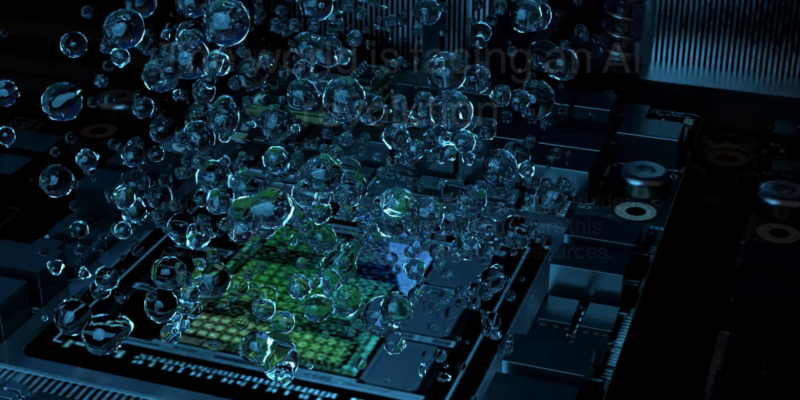
The duo has developed a system that submerges computer servers in a specialized liquid designed to effectively absorb heat. Setting Ferveret’s Adaptive Phase Cooling (APC) system apart from existing liquid cooling is the presence of smaller bubbles that detach more frequently, resulting in accelerated heat transfer.
Already, Ferveret’s innovative solutions are being tested by companies such as CleanSpark, FuriosaAI, and Switch. Tests conducted in collaboration with UCLA’s Samueli Computer Science Department reveals that the APC enhances computational power efficiency by a notable 15% over current liquid cooling solutions. Ferveret suggests that these savings, paired with their power control system could allow for up to 35% more tokens from AI models using the same power.
The Journey from Nuclear Reactors to AI
The Azizian-Bucci partnership kicked off at MIT back in 2013, where the duo was involved in fine-tuning heat transfer in nuclear reactors. The tech that followed saw Azizian veer towards cooling chips at giants such as Microsoft and Nvidia. During a 2017 visit to a data center, he was struck by the inefficiency of traditional air cooling methods, which were responsible for a whopping 40% of a data center’s power consumption.
This realization led to the birth of Ferveret in 2021—an entity founded on the groundwork laid during their stint with nuclear reactors. As AI grapples with the need for more computing capacities, data centers are increasingly exploring liquid cooling. Most go down the route of immersion cooling that boils the liquid to enhance heat transfer. Bucci rationalizes this preference by noting that “liquid is a superior heat transfer medium compared to air. When boiling, it removes heat more effectively due to the energy required for phase change.” Yet, the complexity inherent in boiling then mandates constant monitoring of pressure, temperature, and fluid inventory.
Moving Towards Modular and Efficient Solutions
The solution advanced by Ferveret employs subcooled boiling, using a liquid with a low boiling point and devoid of harmful PFAS chemicals. In their system, the liquid forms smaller bubbles that detach more frequently, hastening the heat transfer process. This system, with its modular structure, facilitates easy maintenance and deployment, fitting comfortably into existing infrastructure. In addition, Ferveret has developed control software that optimizes power usage for each server, significantly upping efficiency.
Ferveret’s technology, while boosting data center efficiency, also allows functioning in remote locations with ample renewable energy resources but a dearth of cooling facilities. Such regions include areas like Africa and the Middle East, whose solar energy opportunities are offset by limited water resources.
With talks underway with leading cloud computing companies and a place in Nvidia’s Inception, a venture for startups, Ferveret plans to ramp up their partnerships. Their goal? To allow for the expansion of AI without further straining the environment. As Azizian puts it, they want “to help data centers extract more tokens from available power.”
For a deeper dive into their endeavours, see the original article hier. If your company wishes to explore the frontiers of AI automation solutions, visit implementi.ai.


