

 Unter
Unter Unlocking the Potential of Protein Design: The Role of AI and Machine Learning
The functionality of a protein is closely linked to its structure, which results from the arrangement of amino acids, the fundamental building blocks of proteins. Understanding this correlation is pivotal in grasping how proteins operate and how we can engineer them for unique purposes.
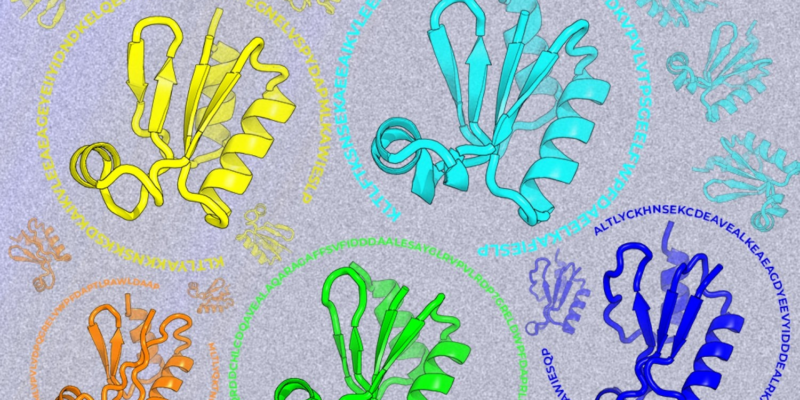
Researchers who aim to create new proteins use a two-pronged approach, especially when they’re designing proteins that could interact with disease-causing agents in our cells. Initially, they’d concentrate on the desired structure. Following that, they apply a machine-learning framework to generate various sequences that might form the intended structure.
It is fascinating to note the beauty of nature’s diversity, where numerous amino acid sequences can create the same protein structure. However, the reverse is also true. A single sequence might display different structures based on its flexibility or certain functional triggers. This complex phenomenon presents a significant hurdle when trying to design proteins using artificial intelligence. The AI must be smart enough to identify the multitude of sequences that may result in the same structural fold.
Challenging Traditional Success Indicators in Protein Design
Traditionally, the effectiveness of protein design models is gauged by their competency to replicate sequences that are chosen through evolutionary processes. However, Amy E. Keating, a leading figure from the Biology department, states that this may not be the most efficient method for protein design. Her recent work underscores the constraints of this traditional approach.
Meanwhile, a novel machine-learning framework, PottsMPNN, designed to integrate the physical rules that dictate protein structure and stability, has gained prominence. This sophisticated model enhances sequence creation, improves predictions related to the potential impact of mutations on protein stability, and offers a more refined understanding of the sequence-energy landscape, crucial for predicting protein behavior.
Embracing the New in Protein Design
The realm of biological research has undergone considerable changes with the advent of machine learning. This technology has bolstered the reliable production of protein structures and sequences. Foster Birnbaum, a graduate student deeply involved in this field, introduces the strategic use of ‘noise’ or variations during training. This technique reduces the model’s inclination to overly replicate native sequences, hence broadening the range of structures it can produce.
PottsMPNN excels in modeling the sequence-energy landscape accurately by capturing interactions between amino acids using pairwise distribution. Adding evolutionarily related sequences during training further enhances the model’s learning, equipping it to understand how different sequences can yield the same structure.
Anticipating the Future of Protein Design
As we continue our foray into protein design, the scope for biological engineering widens, ushering in an exciting—albeit potentially overwhelming—new era. The momentum and optimism in the field are infectious. For the future, Birnbaum envisions refining the model for specific tasks to optimize predictions regarding mutation effects. In the same vein, Keating sees their methods as a way to construct innovative proteins for a broad spectrum of applications, setting a sturdy groundwork for upcoming breakthroughs.
For AI solutions tailor-made for your business, visit implementi.ai. Explore how AI can revolutionize your operations.
Read the original news hier.


