

 Unter
Revolutionizing 3D Design with InstructMesh: A New Era of AI-Driven Fabrication
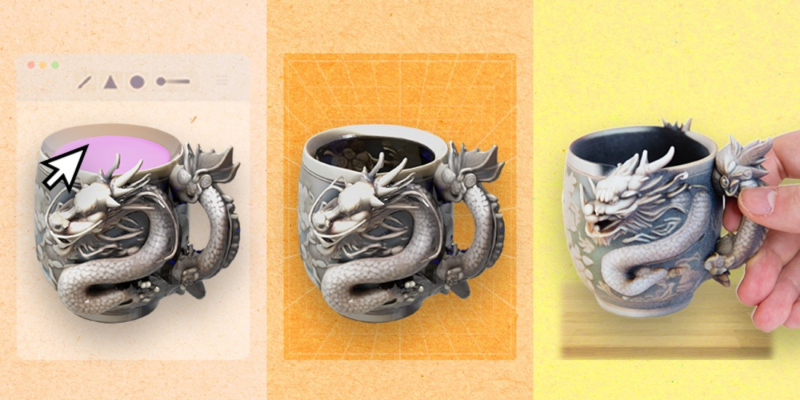
In a world where “what you see is what you get” is the guiding principle for most software engineers, creating programs where the content you edit is identical to the final product should be a given. But when we enter the realm of generative AI systems for 3D printing, the waters get a bit muddy. Here, you might design a stunning coffee mug that, unfortunately, can’t hold a drop of coffee. But why?
The trouble bubbles around AI models being perceptive about how an object looks but neglecting its functionality. Typically, this boundary results in beautiful designs that just aren’t practical when subjected to real-life scenarios. Even when you roll up the sleeves to correct these model errors, the task can be overwhelming especially if you’re a 3D design novice.
Now, allow us to introduce InstructMesh, a brilliant innovation that’s taking the 3D design and printing world by storm. Spearheaded by research teams from MIT’s CSAIL, Google, and Northeastern University, InstructMesh clarifies the process, resulting in functional household items, accessories, and even robots. The process is streamlined: generate a 3D design from a prompt, highlight parts of the blueprint needing refinement, and print. This intuitive, AI-powered interface understands the look of your desired design, and what edits users want, catering to both experts and those new to the 3D design phenomenon.
Some of the creative applications produced by CSAIL researchers using InstructMesh include everyday items with a twist. Picture a coffee mug embraced by a dragon, a whistle shaped like a radiant shell, or glasses that sprout butterfly wings. An unforgettable example is an octopus-like dispenser that pours drinks from each of its tentacles. Not only does InstructMesh render visually pleasing objects, but it also shines in its unique way of following prompts.
So, what’s the secret sauce behind InstructMesh? In simple words, it’s a marriage of Microsoft’s TRELLIS system and the large language model GPT-4, the powerhouse behind ChatGPT. The amalgamation of visual and textual knowledge paves the way for a more interactive and immersive design experience.
InstructMesh is not just about looks; its capability extends to real-world usability too. Take for instance a knee brace designed to mimic the look of denim by MIT scientists, which would blend seamlessly with a patient’s jeans. It’s also proving to be essential in robotics, aiding in creating enclosures for wireless components—just imagine a “bristle bot” shaped like a vibrant shrimp.
As for user experience, when put to the test, InstructMesh impresses. The team had TRELLIS recreate popular 3D models from Thingiverse. Despite nearly 80% of these models having structural flaws, beginners were able to identify and correct these errors about 90% of the time using InstructMesh. Proof positive of the tool’s user-friendly nature.
Looking towards the future, the lead author of the study, Faruqi, now with Google, anticipates integrating InstructMesh into augmented reality platforms. Just imagine describing what you need in your immediate surroundings, and having it 3D printed right then and there. Future iterations may also include adding physics simulations to anticipate how designs react to real-world situations, contributing to its value.
In conclusion, InstructMesh represents a significant step forward in AI-driven 3D design. It’s not only accessible but also practical for users at all skill levels. As technology forges ahead, tools like InstructMesh promise to bridge the gap between imagination and reality. So, are you ready to explore the universe of AI automation for your company? Discover more at implementi.ai. Want to dive deeper? Visit the original article hier.


