

 Unter
Unter React-Agenten mit LangGraph erstellen: Ein Leitfaden für Anfänger
LangGraph and React Agents: A New Era in AI Development
Artificial Intelligence continues to evolve at an unprecedented pace, with intelligent agents — capable of reasoning and reacting to their environment — leading the charge. Enter LangGraph, a cutting-edge open-source framework that simplifies the task of building such agents. With LangGraph, developers can seamlessly integrate language models with graph-based workflows. A perfect complement to LangChain, this tool paves the way for the creation of sophisticated, reactive agents tackling intricate tasks with ease.
Experience the Innovation of LangGraph
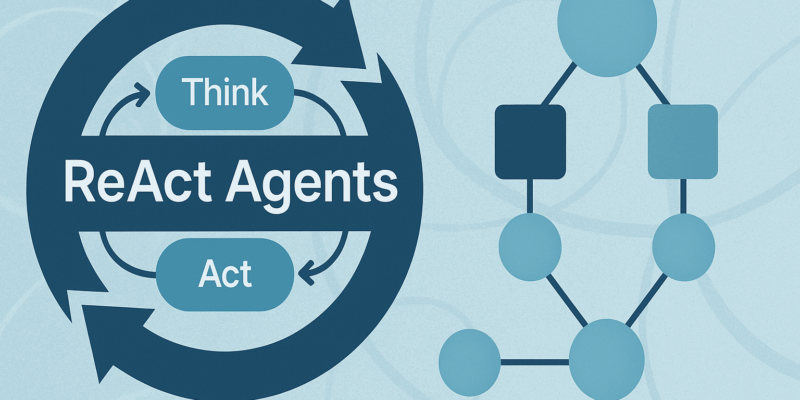
Traditionally, agent behavior modeling has followed linear pipelines. LangGraph departs from the norm, charting a new course with its unique graph-based approach. This method facilitates the representation of logic and data flow with graphs, resulting in branching, looping, and conditional execution. Simply put, it’s a robust method for designing real-world agents that mimics human reasoning patterns. People often reconsider decisions, adapt to new knowledge, and weigh various options — LangGraph holds the same capacity.
Furthermore, LangGraph’s compatibility with the LangChain’s ecosystem stands out as a notable asset. Developers can capitalize on pre-existing tools and elements, which is a considerable benefit. Think about asynchronous execution, persistent state management, and a modular design—all leading to a scalable and maintainable code. Additionally, LangGraph simplifies the debugging and visualization processes, a critical aspect when creating complex agents interacting with different APIs or systems.
A Launch Pad for React Agent Development
Getting started with LangGraph requires a fundamental understanding of Python and the LangChain framework. Here’s the drill: You start by outlining your graph’s nodes, which symbolize separate action points or decision junctions. Based on your agent’s task logic, you next connect these nodes. For instance, when developing a customer support bot, the nodes could signify question routing, information retrieval from a knowledge base, and escalation to a human when required.
Powering up each node calls for a language model, like OpenAI’s GPT, and some custom logic to interpret and respond to user input. The orchestration of these complex interactions is where LangGraph shines, ensuring that your agent traverses the correct graph path, which is dictated by current context and user interactions.
LangGraph’s versatility allows it to be tailored to an array of applications ranging from virtual assistants, customer service bots, research tools, to proactive productivity agents. Developers gain the advantage of quick iterations, testing varied graph configurations, and language model prompts to optimize their agents for distinct tasks.
In essence, LangGraph stands as a significant stride in the creation of intelligent and reactive agents. By combining language models’ power with graph-based logic’s structure, LangGraph offers an intuitive, potent framework for constructing AI systems that can reason, adapt, and act effectually. Seasoned developers and AI novices alike will find in LangGraph the toolbox needed to bring their innovative ideas to life. To delve further into the details, access the comprehensive guide and code samples hier.


