

 Unter
Unter Eine Revolution in der Robotik: Der Durchbruch des MIT im Bereich des räumlich-zeitlichen Gedächtnisses
An intriguing milestone has been reached by MIT researchers for all who have ever misplaced a tool or component on a busy workday. They’ve created a memory system for robots that’s akin to a factory worker’s ability to remember where she left an item out of place. Unlike humans, robots have historically struggled with this type of “spatiotemporal” memory, a gap the research team aimed to bridge. Now, they’ve successfully developed a long-term memory framework that allows robots to form and recall a detailed mental model of complex, large-scale environments quickly and effectively.
Stellen Sie sich vor, Sie könnten einem Roboterassistenten Aufgaben übertragen, indem Sie einfach Sätze sagen wie: “Hol bitte das Bauteil, mit dessen Montage wir gestern Abend begonnen haben.” Dieses einst futuristische Szenario rückt immer näher daran, ein ganz normaler Bestandteil unseres Arbeitsalltags zu werden. Um dies zu ermöglichen, hat das Team fortschrittliche Kartendarstellungen mit detaillierten Umgebungsbeschreibungen kombiniert. Während sich der Roboter im Laufe der Zeit fortbewegt, sammelt und speichert er diese Informationen. Der Roboter kann dann problemlos auf diesen Speicher zugreifen, um komplexe Fragen zu seiner Umgebung in Alltagssprache zu beantworten.
The advantages of such a system are plentiful – from increased accuracy to fast, real-time use. It’s not only groundbreaking for robotics but also opens doors in other domains such as augmented reality systems for anomaly detection by maintenance workers or assisting commuters with wayfinding. Associate professor at MIT, Luca Carlone, articulates, “If we want robots to work side-by-side with humans and interact better with humans, they must speak the same language”.
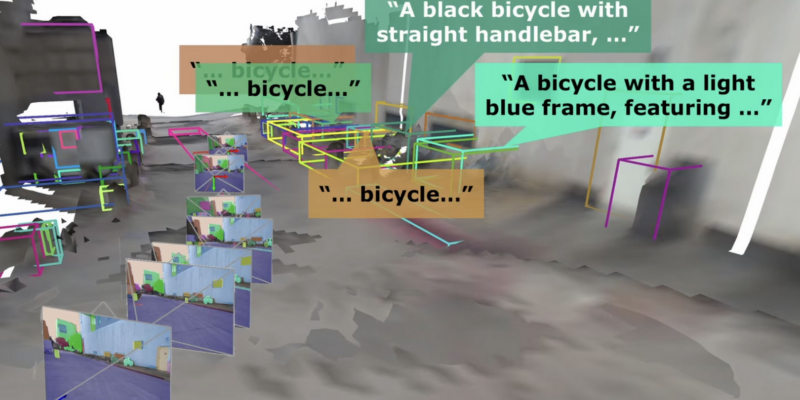
This memory framework, which blends computer vision and robotic mapping, is a real game-changer. They’ve created a unique approach called Describe Anything, Anywhere, Anytime, at Any Moment (DAAAM). With DAAAM, as a robot traverses its environment, it attaches specific descriptions to the objects it encounters. For instance, if the robot is on the MIT campus, it might identify a certain building as the Stata Center, detailed with a particular style of architecture. It then stores these details efficiently for quick and accurate retrieval later on.
Looking ahead, there are plans to enhance the DAAAM framework to capture significant environment events and integrate a system’s confidence level into its responses. Associate researcher Gorlo states, “Ultimately, we want to have robots that can help with any sort of tasks. With this framework, we are trying to create the foundations to enable a generalist agent that can do anything you ask.” For more in-depth information, check out the Originalnachrichten hier.
Möchten Sie erfahren, wie KI-Automatisierungslösungen Ihr Unternehmen voranbringen können? Besuchen Sie implementi.ai and discover how AI can revamp your business operations. With advances like these, we’re drawing closer to a future where AI and robotics become integral members of our daily work teams.


