

 Przez
Przez Przyszłość sztucznej inteligencji: od bezpieczniejszych odpowiedzi do szybszego myślenia
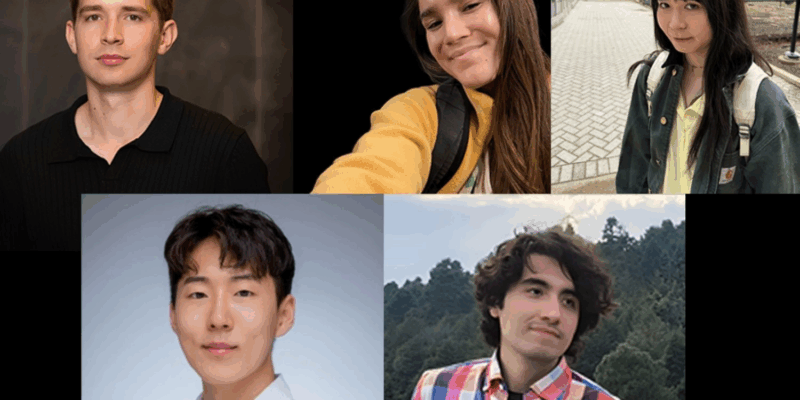
The influx of innovative tools and technologies in today’s hyperconnected world often depends on users’ perceptions of their reliability and value relative to existing ones. This is particularly true for Artificial Intelligence (AI), where its acceptance can be a tremendous hurdle. Keeping this in mind, five groundbreaking PhD students from the inaugural class of the MIT-IBM Watson AI Lab Summer Program are pioneering the future of AI technology. They’re working tirelessly to make AI more trustworthy, efficient, and useful across different domains.
Building Trust in AI and Beyond
The phrase, “trust but verify,” has never been more applicable as when referring to artificial intelligence. Andrey Bryutkin, a PhD student from MIT, has taken a deep dive into the trustworthiness of Large Learning Models (LLMs). Under the mentorship of IBM Research’s Veronika Thost and MIT’s Marzyeh Ghassemi, his research is focused on tapping into inherent structures, such as complex equations and conservation laws, to construct models that are robust and dependable.
Bryutkin’s team is tackling a significant problem – the “uncertainty of uncertainty” in LLMs, where traditional methods using small neural networks (probes) often fall short in detecting unreliable outputs. He aims to rectify this by analyzing hidden aspects such as activation vectors and final tokens of LLMs using prompt-label pairs, which not only helps identify problematic data regions but also uncovers labeling inconsistencies, thereby strengthening the construction of reliable AI systems.
Pushing Boundaries: From Dreaming to Grounding AI
However, AI trustworthiness is not the only hurdle being tackled. Physics PhD student Jinyeop Song is addressing “hallucinations” in LLMs. By incorporating trustworthy external knowledge sources like Freebase and Wikidata, Song aims to help LLMs retrieve accurate information more efficiently. To do so, he is working with IBM Research’s Yada Zhu and Julian Shun from MIT to develop a reinforcement learning framework that streamlines traditional, resource-heavy multi-agent pipelines with a single, intelligent agent.
Meanwhile, Songlin Yang, an EECS postgraduate student, is harmonizing the AI world by reinventing language model architecture to handle long, evolving input sequences cost-effectively. Alongside this, MIT’s Jovana Kondic is revolutionizing AI understanding of visual data, especially complicated elements such as charts that require both optical character recognition and reasoning.
And, not forgetting Leonardo Hernandez Cano, who is uncovering AI applications in digital design. Specifically, he is teaching AI how to generate realistic textures based on user-defined images for CAD applications, paving the way for unprecedented possibilities for digital materials with specific visual properties.
AI: From the Lab to the Real World
The collective endeavor of these budding researchers signifies a unified push towards making AI powerful, yet practical and reliable. By addressing critical challenges in trust, efficiency, and understanding, they, along with their mentors, are laying a strong foundation for real-world AI applications—from scientific research to enterprise software. Their relentless drive is taking AI technology from the labs and onto real-world platforms, shaping our futures in ways yet unimagined.
Discover more about their revolutionary work in the original article on MIT News.


