

 By
By Harnessing Deep Loop Shaping to Enhance Gravitational Wave Detection
Shifting Our Cosmic Perspectives with New Technology
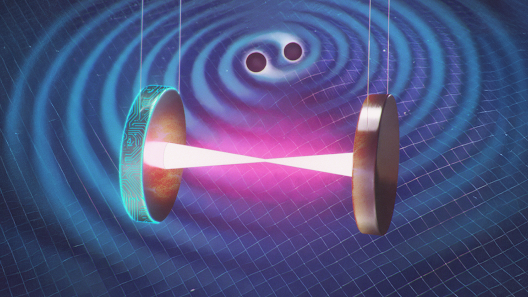
In recent years, gravitational wave observatories have begun to revolutionize our understanding of the cosmos. By utilizing incredibly sensitive instruments to perceive wrinkles in space-time, they bring us groundbreaking information about astronomical phenomena, such as the merging of black holes and the collisions of neutron stars. However, ensuring the stability and precision of their control systems has been a significant hurdle. Enter an innovative solution, known as Deep Loop Shaping, which is set to overcome this challenge.
The Magic of Deep Loop Shaping
Deep Loop Shaping stands out as an advanced AI-driven strategy aimed at optimizing the observatory’s control systems’ feedback loops. What’s fantastic about this method is the ability to balance sensitivity and stability, particularly amid changing environmental conditions, which has traditionally been a tough juggling act. How does it accomplish such a feat? It’s all through the power of deep reinforcement learning, which allows Deep Loop Shaping to retain optimal control strategies.
Diving Deeper Into Our Universe
With a system in place to fine-tune control mechanisms accurately, the potential for gravitational wave detectors skyrockets. Deep Loop Shaping offers the ability to separate real signals from irrelevant noise, turning raw data into concise and reliable information for astronomers. This precision may refine our knowledge of gravitational wave origins and deepen our insights on the creation and evolution of celestial bodies — and, by extension, the totality of the universe.
But the breakthrough doesn’t stop there. Deep Loop Shaping serves as a perfect testament to artificial intelligence’s capacity to advance fundamental sciences. By incorporating machine learning techniques into the physical structure of observatories, researchers aren’t merely enhancing the existing tools but pushing the boundaries of their potential. For instance, Deep Loop Shaping allows systems to adapt in real-time, thus lowering latency and bolstering resilience against unexpected disturbances.
Expanding Horizons with AI
The possibilities opened up by Deep Loop Shaping are overwhelming, extending far beyond the field of gravitational wave astronomy. The principles behind this approach might influence control systems across diverse fields, such as robotics, aerospace, and quantum computing. Currently, its most palpable impact is aiding scientists in distinguishing historical cosmic events more clearly, getting us one step closer to unraveling the universe’s profound mysteries.
For those interested in learning more about this remarkable development, be sure to check out the original news source: Using AI to Perceive the Universe in Greater Depth.


