

 By
By Ray Kurzweil Shares Bold Vision of AI-Driven Future During MIT Lecture
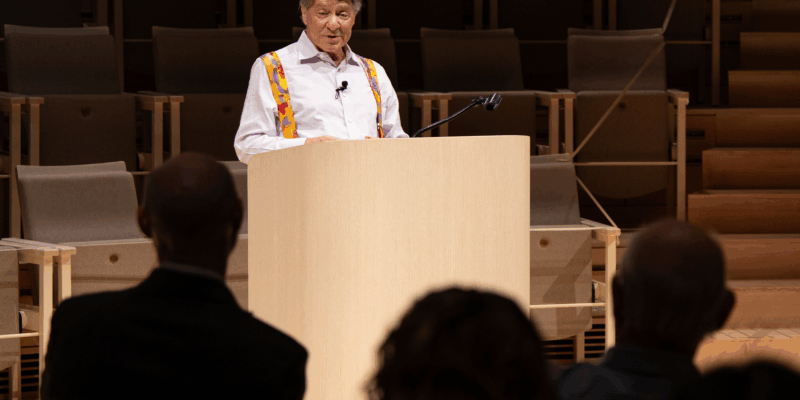
Award-winning innovator, futurist and author Ray Kurzweil once again graced the halls of his alma mater, Massachusetts Institute of Technology (MIT), to receive the distinguished Robert A. Muh Alumni Award. This notable recognition was conferred upon him amid the grandeur of the newly opened Thomas Tull Concert Hall, in a ceremony led by MIT’s School of Humanities, Arts, and Social Sciences.
A Glimpse Into the Mind of a Visionary
In his thought-provoking lecture, titled “Reinventing Intelligence”, Kurzweil projected a future where the boundaries between artificial intelligence and human cognition blur into a singular, seamless entity. He described a reality where nanobots, tiny machines operating at a molecular level, could potentially be introduced into the human brain via capillaries – extending our neural network straight into the cloud. The concept, as Kurzweil puts it, is akin to having an internal smartphone. A paradigm shift of this magnitude, according to his predictions, could manifest as early as the 2030s.
Kurzweil also touched on the exponential nature of technological advancement. Alas, he believes, the common perception is linear in nature and thus fails to appreciate the dramatic shifts that lie ahead. This miscalculation underestimates how quickly technology is advancing, inevitably leading to breakthroughs in various fields much sooner than we anticipate. In particular, he underlines the transformative potential for fields like medicine and longevity, expecting revolutionary strides within the next two decades.
Pioneering Change and Personal Growth
As a key exponent of AI, Kurzweil sees the medical field as one that could undergo a complete transformation. In his view, traditional human trials could soon be replaced by highly accurate, time-efficient, digital simulations – revamping the way we develop drugs and significantly accelerating the process. He termed this potential landmark “longevity escape velocity” – a point which we may reach by 2032. At this milestone, for every additional year a person lives, scientific advances could potentially add another year to their lifespan.
The visionary’s talk was humanized by moments of personal reflection and early inspirations. Kurzweil acknowledged his parents, who fled from Nazi Europe, for fostering his strong belief in the potency of ideas to shape the future. “By the age of 7, I had decided to become an inventor,” he shared. This ambition was catalyzed by his mother’s unwavering support for his imagination and visions. With deep fondness, he also recalled MIT’s significant role in his personal and professional life. The Institute had earlier recognized his contributions in reading technology with the Lemelson-MIT Prize.
An Optimistic Outlook with a Cognizance of Risk
Dean of SHASS, Agustín Rayo, introduced Kurzweil as a prolific thinker, celebrating his conviction in the power of ideas to change the world. While Kurzweil’s predictions brim with optimism, he didn’t shy from considering the dual-edge of technological advancements. “A drone can deliver medicine or a bomb,” he cautioned, emphasizing the moral imperative to manage AI risks responsibly. In his closing remarks, he made a bold prediction – by 2045, AI could augment human intelligence a millionfold. This tipping point, labeled the ‘Singularity’, marks the fusion of biological and artificial intelligence – a transformation Kurzweil believes, we can navigate prudently.
Read the original article at MIT News.


