

 By
By Revolutionizing Warehouse Efficiency: MIT’s AI-Driven Robot Coordination System
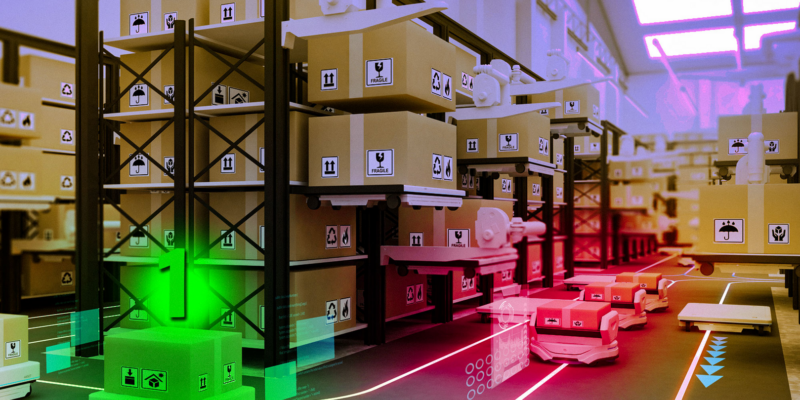
Picture a massive autonomous warehouse, humming with a seamless dance of hundreds of robots dutifully zooming down aisles, gathering and disbursing items to fulfill a constant stream of customer orders. It’s an intricate affair where even the tiniest bottlenecks or inconsequential collisions can snowball into significant delays, risking the overall efficiency of the operation.
Researchers from MIT and tech company Symbotic have devised a groundbreaking solution to this intricate problem – a unique method that automatically smooths out the flow of the fleet of robots. The approach preemptively identifies which robots need priority at any given time based on real-time congestion patterns. If a robot is at risk of getting stuck, the system adapts and places it higher on the priority list, effectively rerouting it to dodge potential bottlenecks.
A potent blend of deep reinforcement learning – an advanced artificial intelligence (AI) technique built to manage complicated problems – and a speedy, reliable algorithm lie at the heart of this system. These resources direct the robots and equip them to react swiftly to any changes in their warehouse environment.
Innovative AI in Action
Inspired by real e-commerce warehouse layouts, this method has shown an impressive 25 percent increase in throughput in simulations, compared to other practices. In a setting where even a 2 or 3 percent throughput spike can mean substantial returns, such an increase is quite the achievement. The system can also adapt rapidly to new conditions, such as altering robot numbers or warehouse layouts.
Masterminds Behind the AI-Powered Innovation
“There are numerous decision-making challenges in manufacturing and logistics where companies rely on algorithms created by human experts. However, we’ve shown that with the power of deep reinforcement learning, we can achieve super-human performance,” says the lead author, Han Zheng, a graduate student at MIT’s Laboratory for Information and Decision Systems (LIDS). Zheng worked on the paper with several colleagues from LIDS and Symbotic, and their research is published in the Journal of Artificial Intelligence Research.
Coordinating hundreds of robots in an e-commerce warehouse is no easy task; it’s even more complex given the dynamic nature of these environments. Traditionally, logistics companies relied on hand-crafted algorithms to judge the optimal movement and timing of the robots to maximize package handling. Nevertheless, in the face of congestion or a collision, these companies could be forced to halt operations for hours to manually resolve the matter.
Recognizing this, the researchers used a neural network model that observes the warehouse environment and decides how to prioritize the robots. Reinforcement learning, a trial-and-error method, helps train the model, rewarding it for decisions that enhance throughput and avert conflicts.
As the neural network interacts with simulations of actual warehouses, the feedback refines the system’s decision-making abilities. It can then acclimate to different warehouse layouts. The system anticipates robot interactions allowing it to proactively plan and prevent congestion.
Once priorities are set, a tested planning algorithm jumps into action, providing each robot with movement instructions. This quick algorithm allows the robots to react swiftly to changes in the warehouse environment.
Beyond the Lab: Real-World Results
MIT’s team tested the system in simulated warehouses that were different from those in the training phase. The results were encouraging — their hybrid learning-based system registered a 25% increase in throughput over traditional algorithms and a random search method, in terms of the number of packages delivered per robot. It also successfully managed congestion caused by conventional methods.
While the system still needs fine-tuning for real-world deployment, these findings underscore the potential benefits of employing a machine learning-guided approach in warehouse automation. Next, in the researchers’ sights is to incorporate task assignments into the problem formulation and scale up the system for larger warehouses with thousands of robots.
This breakthrough research was sponsored by Symbotic. For companies eyeing possibilities in AI automation, a visit to implementi.ai might be valuable. Original news source: MIT News.


