

 By
By MIT Students Awarded Prestigious Hertz Foundation Fellowships
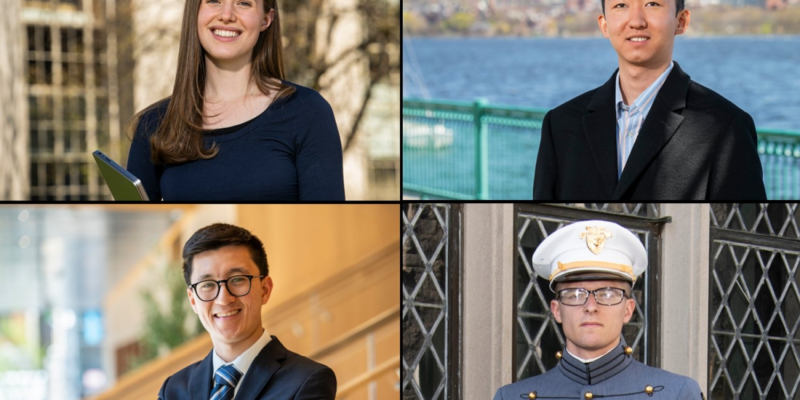
The Hertz Foundation recently shared exciting news regarding its 2026 fellowships. Among the awardees are three MIT students and one incoming graduate student: Annika Marschner, Alvin Q. Meng, Zachary S. Siegel, and Matthew Wanta.
The Hertz Fellowship is a highly esteemed award in science and technology realms. The recipients find themselves in a privileged position, gaining five years of financial backing, including a stipend and full-tuition. This support fuels fellows with significant autonomy, enabling them to delve into groundbreaking research throughout their graduate studies.
Among the eminent folks involved in the selection process was Philip Welkhoff, a Hertz Fellow himself, and the current director of the malaria program at the Gates Foundation. He was particularly astounded by one attribute of this cohort – their fearlessness.
The Fearless Fellows
“This cohort impresses me with their fearlessness in confronting new challenges and progressing the frontiers of science,” Welkhoff noted. Their inventiveness, tenacity, and foresight left him eager to witness what they could achieve under the fellowship’s auspices.
Under the Hertz Foundation fellowship, more than financial support, fellows gain lifelong access to its programs. These programs span events, mentorship, and networking opportunities that have often sparked collaborative startups and led to considerable progress in technology, science, and engineering fields.
MIT Winners on Spotlight
Among this group of distinguished Hertz Foundation Fellows are four individuals connected to MIT. They are part of a toasty group of 19 selected from across the country.
Starting us off is Annika Marschner, a member of the class of ’26. Marschner majored in Mechanical Engineering and is set to commence her PhD work at MIT come fall. Her undergrad research circled around developing unique technologies for bio-interfacing and bio-inspired systems. Marschner looks forward to furthering her work on hardware and control system design in biologically relevant settings, mainly revolving around assistive medical technology and surgical robotics.
Joining Marschner is Alvin Q. Meng, a student in organic chemistry working towards his doctoral degree. Meng’s primary focus is on understanding the basic interactions forming chemical structure and reactivity. He moved to the U.S when he was 10 years old from Tianjin, China.
Then we have Zachary S. Siegel, an electrical engineering and computer science graduate student heading towards a PhD in the Computer Science and Artificial Intelligence Laboratory. Siegel’s research snugly sits at the junction of robotics, cognitive science, and AI. His goal is to develop machines that learn and reason like humans.
Finally, meet Matthew Wanta, an incoming doctoral student that will kick-start his operations research at MIT in the fall. Wanta’s earlier work revolved around machine learning for autonomous systems.
For more details on their exciting journey, be sure to check out the original news article .
Thinking about automating tasks within your company? You might want to consider AI automation solutions with implementi.ai.


