

 Unter
Unter KI und Robotik verwandeln Worte in Möbelentwürfe
Bei der Entwicklung und Herstellung physischer Produkte kommen heutzutage häufig CAD-Tools (Computer-Aided Design) zum Einsatz. Von der neuesten Unterhaltungselektronik bis hin zu Designermöbeln – all dies ist das Ergebnis des effektiven Einsatzes von CAD. Eine unbestreitbare Tatsache bei diesen Tools ist jedoch, dass sie komplex sein können, ihre Beherrschung in der Regel jahrelanges Training erfordert und sie manchmal die Kreativität in den frühen Phasen des Designprozesses hemmen.
Innovatives Design durch Dialog
Um den Weg für barrierefreiere Designpraktiken zu ebnen, hat ein Forscherteam am MIT gemeinsam ein neues, KI-gesteuertes Robotersystem entwickelt. Dieses bahnbrechende System ermöglicht es Nutzern, ihre kreativen Ideen zum Leben zu erwecken und physische Objekte wie beispielsweise Möbel zu gestalten, indem sie ihr Design einfach in natürlicher Sprache beschreiben.
Das System interpretiert diese Beschreibungen, um 3D-Modelle zu erstellen, und setzt Objekte sogar aus vorgefertigten Bauteilen zusammen. “Das Ziel ist es, irgendwann eine Kommunikation und Zusammenarbeit mit einem Roboter und einem KI-System zu ermöglichen, die so natürlich ist wie unsere Gespräche untereinander. Unser System ist ein wegweisender Schritt in diese Richtung”, kommentiert Alex Kyaw, Doktorand am MIT und aktives Mitglied der Fachbereiche Elektrotechnik, Informatik und Architektur.
Text in praktische 3D-Modelle umwandeln
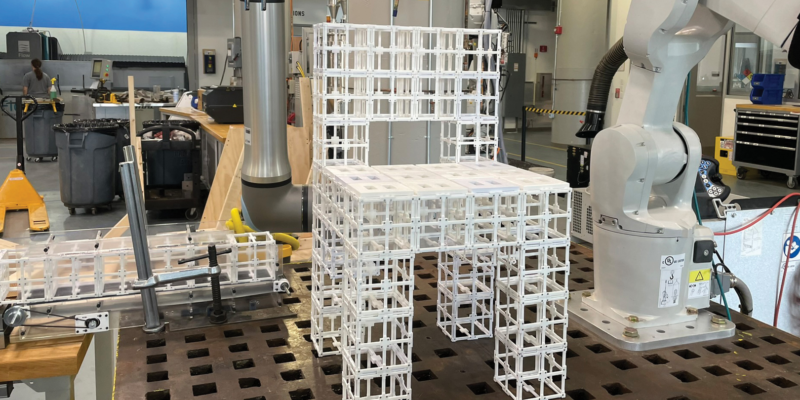
Hinter den Kulissen kommt ein generatives KI-Modell zum Einsatz, das die Textanweisung des Nutzers – etwa “Erstelle mir einen Stuhl” – in ein 3D-Netz umwandelt, das die Geometrie des Objekts erfasst. Anschließend greift die zweite Ebene des KI-Modells ein und analysiert die Funktion des Objekts, um zu ermitteln, wie es aus vorgefertigten Teilen – Struktur- und Verkleidungskomponenten – zusammengesetzt werden soll.
Die Faszination des Systems liegt in dem zweiten Modell, das als Vision-Language-Modell (VLM) bezeichnet wird. Dieses Modell fungiert als “Gehirn und Augen” des Roboters und ist darauf trainiert, sowohl Text als auch Bilder wahrzunehmen. Es interpretiert das 3D-Netz intelligent und entscheidet anhand früherer Erfahrungen und Kenntnisse über ähnliche Objekte, wo die einzelnen Komponenten platziert werden sollen.
Sobald der Konstruktionsprozess abgeschlossen ist, ist es an der Zeit, dass das Robotersystem das Objekt aus diesen wiederverwendbaren Teilen zusammenbaut. Was diese Funktion umweltfreundlich macht, ist, dass diese Komponenten wieder zerlegt und für zukünftige Projekte wiederverwendet werden können, wodurch der Materialabfall erheblich reduziert wird.
Das System hat sich bereits bewährt, was durch die Herstellung von Möbeln wie Stühlen und Regalen belegt wird. Eine Nutzerstudie zeigt, dass die von der KI generierten Entwürfe bei über 90% bevorzugt werden gegenüber solchen, die mit anderen automatisierten Methoden erstellt wurden, wie beispielsweise durch zufällige oder ausschließlich nach oben gerichtete Anordnung der Oberflächenplatten.
Einbeziehung von Menschen und Bewertung der Funktionalität
Was dieses System wirklich auszeichnet, ist sein “Human-in-the-Loop”-Ansatz. Er ermöglicht es den Nutzern, ihre Entwürfe durch iteratives Feedback fein abzustimmen. Alex Kyaw erklärt: „Der Entwurfsraum ist riesig, daher schränken wir diese Unermesslichkeit durch Nutzer-Feedback ein. Angesichts der vielfältigen Vorlieben der Menschen wäre es unpraktisch, ein einheitliches Idealmodell zu entwickeln.“
Das VLM verlässt sich bei der Platzierung von Bauteilen nicht nur auf Vermutungen. Es zeigt ein überraschendes Verständnis für die Funktionalität von Objekten. So versteht es beispielsweise, wie wichtig die Einlagen an Sitzfläche und Rückenlehne eines Stuhls für den Komfort sind.
Dieses neu entwickelte System bietet Anwendungsmöglichkeiten, die weit über den Bereich der Möbelherstellung hinausgehen. Das Team hofft, dass zukünftige Versionen des Systems in der Lage sein werden, komplexere Vorgaben zu verarbeiten und mechanische Teile wie Scharniere und Zahnräder für anspruchsvollere Kreationen zu integrieren.
“Wir wollen Design-Tools deutlich zugänglicher machen”, sagt Randall Davis, leitender Autor und Professor am EECS-Institut des MIT. “Unsere Arbeit belegt, dass der Einsatz von KI und Robotik zur Umsetzung von Konzepten in greifbare Objekte schnell, benutzerfreundlich und ökologisch nachhaltig sein kann.” Wenn Sie mehr über dieses KI-gesteuerte Robotersystem und die dahinterstehende Studie erfahren möchten, lesen Sie den Originalartikel auf der Website von MIT News: https://news.mit.edu/2025/robot-makes-chair-1216.


