

 Unter
Unter Die Neugestaltung der Uferpromenade: Die Vision des MIT für schwimmende Infrastruktur
Many of us think of the waterfront as a static boundary where land meets water – the edge of the city. But for a team of MIT researchers, it’s a dynamic landscape, as changeable as a child’s Lego set. They’ve developed a groundbreaking system called FloatForm, composed of a swarm of mini robotic boats. These bots can combine and reconfigure themselves into various structures on water, with little to no human intervention required.
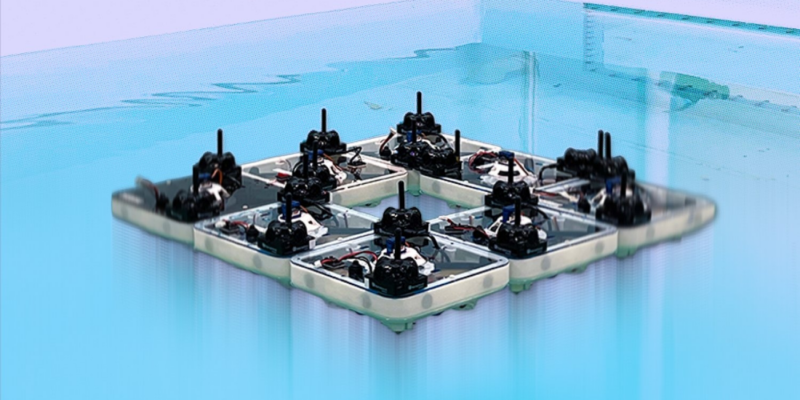
Imagine a small square robot the size of a dinner plate, equipped with its own thrusters, sensors, and magnetic latches. This army of self-efficient vessels paints a future where waterfront infrastructure can adapt and transform, much like the blocks in a Lego set. Temporary platforms could be assembled during emergencies, pop-up markets could emerge on urban canals, and floating stages for festivals could appear and disappear as needed.
A Concept of A Dynamic, Adaptable Waterfront
Daniela Rus, the Panasonic Professor of Electrical Engineering and Computer Science at MIT, envisions our future waterfront as an extension of the city itself. “Our FloatForm project sees the waterfront as a programmable part of the city,” she explains. These autonomous boats could self-organize into bridges, platforms, and other structures on demand, reshaping our mobility, emergency response, and even the way we embrace public space.
Creating Through Flexibility and Modularity
Collaborator Wei Wang, now leading the Marine Robotics Lab at the University of Wisconsin at Madison, shares this vision enthusiastically. He adds, “We’re turning static water surfaces into dynamic, programmable spaces.” This concept brings to mind urban environments that aren’t fixed, but can autonomously expand, contract, or reconfigure according to our needs.
To realize this vision, Alejandro Gonzalez-Garcia, a former MIT researcher, emphasizes the use of a modular system to create larger systems on the water. This could mean forming new bridges to alleviate traffic during emergencies, or creating floating markets and stages – a powerful way to make our cities more livable by taking advantage of water surfaces.
Learning from Nature
The team took inspiration from nature – specifically from fire ants, which survive floods by linking their bodies into living rafts. The FloatForm system doesn’t require a central computer to direct every move; instead, it uses a lightweight central planner who intervenes as needed. This approach allows the robots to independently navigate, avoid collisions, and adapt to changes, making the system more resilient with better scalability.
On MIT’s campus, the researchers have already seen an eight-robot fleet successively assemble into predetermined shapes, latch into stable structures, disassemble, reconfigure, and move across a pool as a single entity. They believe that this adaptive system has applications beyond urban settings. It could prove advantageous for offshore inspection, temporary construction platforms, and environmental monitoring.
Gonzalez-Garcia concludes, “From Venice to the Netherlands, to the fjords of Norway – any city with a river can take advantage of this.” But it’s not only about leveraging existing water bodies; FloatForm also raises an important question. How else can we use water to enhance our lives and our environments?
This work was first covered in an MIT news article. To find out how AI automation can transform your business, check out implementi.ai!


