

 By
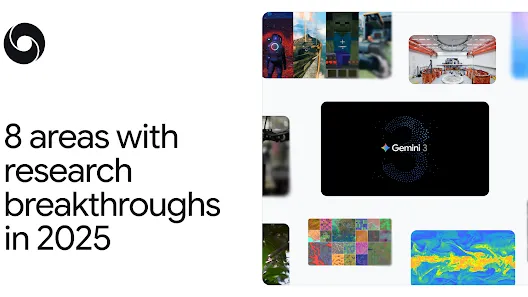
By Google 2025 Recap: Research Breakthroughs of the Year
Unleashing the Future with Gemini 2 and Beyond
Imagine a world where artificial intelligence isn’t just a concept but an integrated aspect of daily living – that’s the future Google’s DeepMind aimed for when it unveiled Gemini 2 in 2025. This titan of the tech world stunned us with a model that wasn’t just about machine learning. Through the harmonious union of deep learning and advanced reasoning, Gemini 2 shot beyond the realm of ordinary general-purpose AI. It shattered the barriers holding back interaction across a host of modalities. Suddenly, we see AI communicating through text, images, code, and even audio, reflecting just how far technology has come in a seemingly short span.
But of course, no great AI transformation would be complete without taking safety into consideration. Google knew this all too well, and in 2025, the tech leader prioritized AI safety like never before. The research community worked laboriously, developing effective oversight measures and expanding on reward modeling possibilities to ensure AI behaved as expected. Predictability and stability became key as AI found itself intertwined with vital real-world applications and decision-making processes.
Taking Giant Leaps with Robots, Health AI, and Sustainability Research
Robots. They’ve always fascinated us, haven’t they? But Google didn’t stop at fascination. Instead, it propelled robots forward by incorporating large language models into their systems. With improved interpretation of human instructions and adaptability to varying environmental complexities, a new generation of robotic assistants emerged. Robots no longer seemed distant, Hollywood-inspired fantasies, but real-world helpers with an uncanny level of smarts and self-reliance.
As Google made strides in AI and robotic technologies, it cast an eye toward one of the most significant sectors: healthcare. 2025 was a phenomenal year for Google Health’s AI research, and the world witnessed the dawn of predictive models and diagnostic tools unlike any before. Through this pioneering work, AI found itself predicting disease onset faster and more accurately than conventional methods, hinting at a future where healthcare isn’t just reactive but proactive and personalized.
Yet, the tech goliath wasn’t done. Alongside healthcare, Google targeted the planet’s most challenging issue: climate change. Groundbreaking research went into employing AI for better climate modeling, deforestation tracking, and optimizing the use of renewable energy. These developments not only deepened our understanding of the world we inhabit but also amplified sustainability efforts on a global scale.
The Uncharted Territory: Quantum Computing and Language Technology
The year 2025 will forever be remembered as a game-changer for quantum computing. Google’s Quantum AI team didn’t just make strides; they leapfrogged their way to set new standards in error correction and qubit stability. This massive advancement brings us tantalizingly close to unveiling practical, scalable quantum computers, poised to tackle problems that remain elusive to conventional computing.
Last, but certainly not least, language technology experienced immense improvement. Google’s models have not only become more culturally competent but also contextually accurate. By understanding and improving low-resource languages, digital communication is now more accessible and inclusive than ever.
In light of these advancements, it’s impossible to miss AI’s transformative touch in scientific research. From speeding up protein folding predictions to supporting mathematical theorems, AI tools are now heralding an era of exploration that seemed too challenging or time-consuming just a few years ago. To explore the full scope of these breakthroughs, don’t miss out on the original article on DeepMind’s blog: Google’s Year in Review: 8 Areas with Research Breakthroughs in 2025.


