

 By
By How Apple Lost the AI Race Ahead of WWDC 2025
As Apple gears up for WWDC 2025, a cloud of unease looms over the tech giant. What was once known for awe-inspiring innovation is seemingly grappling with a different narrative – one painted with delayed features, underwhelming AI capabilities, and growing user discontent. It seems the fading lustre of “the apple of innovation” is being replaced with glaring warning signs.
In the previous year, Apple soared high on promise-filled skies. Among its ambitious plans was to revolutionize coding in Xcode using AI with Swift Assist and upgrade Siri to become context-aware, matching up to Google Assistant and ChatGPT. Users were given hope of seamless cross-app functionality driven by voice commands. But as the WWDC 2025 draws closer, the reality seems less rosy. Swift Assist is missing in action, Siri’s major upgrade is constantly delayed under the shadow of internal setbacks, scathingly described as “ugly and embarrassing”. The annual keynote has turned into a wishlist rather than a roadmap in the eyes of developers, who were once the tech giant’s most loyal constituents.
The technical aspect of Apple’s AI models does little to improve the situation. They are nowhere near the competitors like OpenAI and Google, in terms of their advanced public model that boasts a (not so whopping) 3 billion parameters. Apple’s research itself acknowledged a shortcoming – their models rely more on pattern identification than reasoning, a characteristic lagging behind in the era of intelligent assistants. While the company’s models closely matching the performance of GPT-4 Turbo are still in internal testing grappling with reliability issues, its competitors have launched models with 150 billion parameters. Apple’s insistence on on-device AI, although privacy-respecting, has the drawback of limiting performance and scalability.
Faltering Beneath the Surface: Apple’s Infrastructure Deficiencies
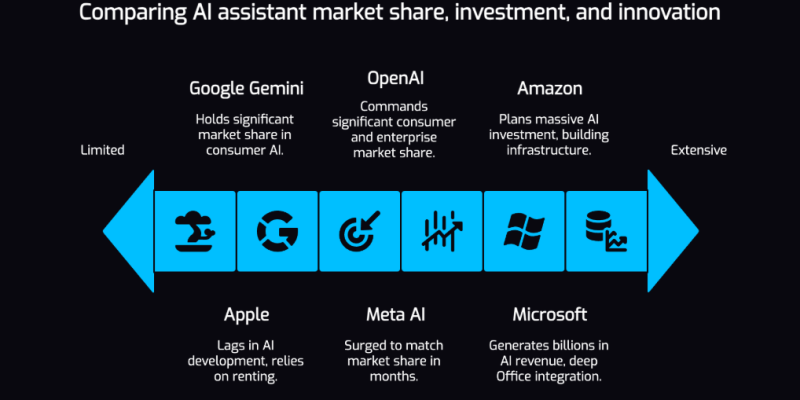
Apple’s predicament becomes more complicated when you look at its hardware story. Despite owning powerful Neural Engines, like the M4 chip that boast of 38 trillion operations per second, Apple lacks the AI infrastructure to drive innovation. Their fleet of 50,000 GPUs looks mediocre compared to competitors who operate hundreds of thousands of advanced processors. Instead of building its cloud infrastructure, Apple is essentially renting the computing power from rivals like Google and Amazon. This not only hurts its independence but also aids its competitors in the AI race.
WWDC 2025: Apple’s Conundrum
Reports from Bloomberg suggest that the WWDC 2025 agenda may need scaling down. Future-forward previews are likely to be replaced by modest updates and Apple releasing its 3-billion-parameter Foundation Models to third-party developers. However, in comparison to the offerings from Microsoft and Google, this initiative falls short, looking more like a trial version than a progressive leap. Many developers, noticing these limitations, have begun to realign their focus towards platforms showing present results instead of distant promises.
Apple’s privacy-centric approach, albeit noble, has constrained its ability to harness the cloud computing capabilities needed for advanced AI. This strategic choice has, in turn, diminished the presence of Apple’s AI in both consumer and enterprise markets. Siri still finds its primary application in setting timers, whereas AI like ChatGPT, Gemini, and Meta AI, are performing complex tasks and driving productivity tools across several industries.
Presently, Apple’s situation bears a chilling resemblance to the past downfalls of BlackBerry and Nokia, both once reigning champions who failed to evolve. Today’s tech-savvy users demand smart, AI-powered features, and for many, Apple’s devices are starting to feel obsolete. Surveys indicate that a considerable number of iPhone users, particularly younger demographics and professionals, might migrate to platforms offering better AI integration.
The Countdown Begins for Apple’s AI
Pundits perceive 2025 as a pivotal year for Apple’s AI mission. If the company doesn’t bring about meaningful AI advancements rapidly, it risks losing influential users. By 2026 or 2027, the damage to its ecosystem may be beyond repair. While Apple struggles, competitors like Google, Microsoft, Meta, and Amazon are pouring over $300 billion into AI infrastructures this year alone. Their platforms are continually evolving, and in comparison, Apple’s significant AI features seem distantly dreamy.
Apple’s reputation was built on audacious innovation. However, when it comes to AI, the company’s strategy appears rather reserved. It seems to prioritize privacy and control over openness, speed, and scale. WWDC 2025 may no longer be a turning point for Apple, but rather an indicator of how far behind it has slipped. It remains to be seen if users stick around long enough for Apple to catch up, or they start moving towards platforms that are already in tune with the future. Read more about the crisis HERE Unite.AI.


