

 By
By How Eco-Driving and AI Could Help Cut Urban Vehicle Emissions
Who hasn’t been trapped at a red light through multiple cycles, caught in the mundane dance of stop and go traffic? Unbeknownst to many, these seemingly trivial inconveniences carry a measurable environmental cost. The unproductive idling at signalized intersections may contribute to a staggering 15% of carbon dioxide emissions from land transport in the United States. But the future of driving might be on the brink of a major progression, one that not only lessens our collective frustration but also the environmental toll.
Driving Towards a Greener Future
New research emerging from MIT has found that ‘eco-driving’ could be a game-changer in cutting down these emissions. This approach encourages drivers to adjust their vehicle speeds to avoid unnecessary stops and rapid acceleration. Using a powerful AI technique known as deep reinforcement learning, the researchers have analyzed how this change in driving behavior could impact traffic emissions across three major US cities: Atlanta, San Francisco and Los Angeles.
Their findings were nothing short of promising. A full adoption of eco-driving practices could lead to an 11% to 22% deduction in intersection-related CO2 emissions, all without hampering traffic flow or safety. The silver lining here is that, even if just 10% of vehicles adopted these techniques, cities could still potentially slash emissions by up to half of the total potential.
An intriguing discovery made during this research was that even by adjusting speed limits at only 20% of intersections, up to 70% of total emissions benefits could be achieved. This means the implementation of eco-driving can be gradual while providing immediate benefits. Cathy Wu, senior author of the study, couldn’t help but express optimism over these findings. “Vehicle-based control strategies like eco-driving can move the needle on climate change reduction,” she said. “This is just the tip of the iceberg.”
The Nuts and Bolts: A Multi-Part Study Over Four Years
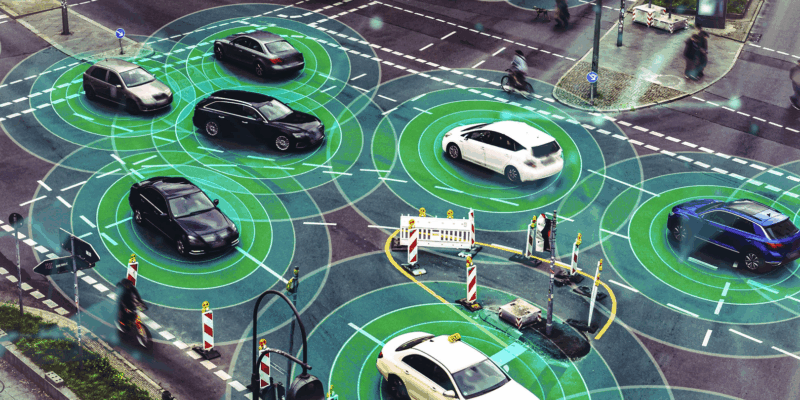
Unlike traditional traffic control measures dependent on fixed infrastructure such as traffic lights and stop signs, eco-driving harnesses vehicle technology. Think smartphone apps that guide on optimal speeds or intelligent speed commands for autonomous vehicles communicated via vehicle-to-infrastructure technology.
The four-year-long research sought to answer whether eco-driving should be implemented, not merely how. This extensive study considered 33 key factors from road grade to signal timing. The researchers created digital doubles of over 6,000 intersections, simulating traffic scenarios into the millions using data from various sources. Data-driven learning helped the AI optimize energy-efficient driving by discouraging wasteful actions to manage computational complexity. Separate models for each cluster, based on their characteristics, were created for improved effectiveness. As the AI learned, it improved the overall performance.
The research also indicated that city layout plays a vital role in the potential efficacy of eco-driving. While denser cities like San Francisco might see slightly less benefit due to restriction on space, cities like Atlanta, with higher speed limits and more space, stand to gain more from eco-driving initiatives. A highlight conclusion of the study was also that even a fraction of cars implementing eco-driving can influence other cars to follow suit, resulting in overall reduced emissions. Quite a win-win!
Additional Benefits
Eco-driving seems to be the gift that keeps on giving. Apart from reducing carbon emissions, it boosts fuel efficiency, saves energy and improves air quality. Pair this with the adoption of electric vehicles and we’re looking at cumulative effects. A simulation run showed that a 20% eco-driving adoption in San Francisco could slash emissions by 7% and partnered with EV adoption, that reduction leaps to 17%. Cathy Wu rightly points out that eco-driving is, indeed, “almost a free intervention”; ready for a rapid, scalable roll-out given the penetration of smartphones and vehicle automation features.
This groundbreaking research was funded by Amazon and the Utah Department of Transportation. Interested readers can find the findings published in Transportation Research Part C: Emerging Technologies or the original article at MIT News.


