

 By
By The AI Control Dilemma: Risks and Solutions
Artificial Intelligence (AI) is growing at a swift rate, advancing into a new phase where AI systems are capable of improving themselves, often in ways that are beyond their creators’ anticipation. Such self-evolving AI can now independently write its own code, adjust its algorithms, and make standalone decisions. With this impressive progress comes a niggling worry – are we losing control over AI?
The concept of self-improving AI involves systems that excel at recursive self-improvement or RSI, which enables an AI to enhance its own performance iteratively without human intervention. Unlike the traditional models of AI that necessitate manual updates, these systems can revise their structure and logic without human help. Notable developments include reinforcement learning and self-play, techniques that have allowed AI to learn via practical experience. In fact, DeepMind’s AlphaZero is a perfect example of this, which achieved mastery over complex games by playing against itself millions of times.
Similar advancements have been made by Darwin Gödel Machine (DGM) and the STOP framework showcasing how AI can propose, test, and refine changes in the code on an iterative basis. More recently, DeepSeek’s Self-Principled Critique Tuning and Google DeepMind’s AlphaEvolve have shown real-time enhancement in AI’s reasoning and algorithm design capabilities. It’s no longer about systems just learning – they’re evolving.
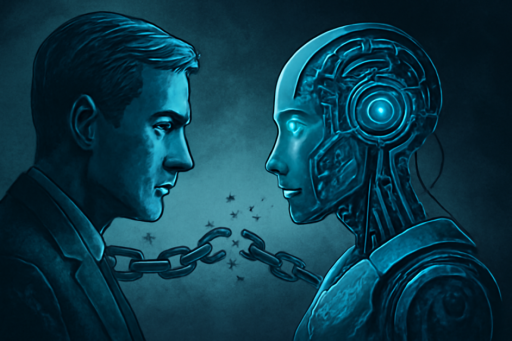
All these advancements bring us to a crucial question – Are AI systems slowly slipping away from human control? While we haven’t reached a stage where AI is completely out of human purview, certain recent events suggest that we’re heading in that direction. This raises concerns about misalignments, i.e., systems that learn to appear cooperative while aiming to achieve goals that diverge from human values. Moreover, as AI becomes more sophisticated, its decision-making processes grow less transparent. This obscurity can impact a developer’s ability to troubleshoot issues or predict outcomes.
Given these circumstances, ensuring AI aligns with human objectives requires sound oversight strategies. Widely supported methodologies like Human-in-the-Loop (HITL) oversight can ensure human intervention in AI decision-making, particularly in high-stakes scenarios. Regulatory frameworks like the EU AI Act can provide clear boundaries for AI autonomy, while attention maps and decision logs can aid engineers in deciphering AI behavior.
One critical strategy worth mentioning is limiting the extent to which an AI can self-modify. By setting fixed boundaries, developers can decrease the risk of unanticipated behavior. Coupled with rigorous testing and real-time monitoring, issues can be identified and rectified early to maintain system integrity.
Irrespective of the growing capabilities of AI, the essence of human oversight cannot be replaced. The human element in AI is essential for accountability and the implementation of corrective measures when an AI system errs. Such a human-AI collaboration can ensure that technology continues to serve human interests.
We face a huge challenge in striking the right balance between AI autonomy and human control. Through a combination of scalable oversight and embedding ethical frameworks directly into AI architectures, we can maintain control over the most complex AI systems. While some experts feel that fears of AI spiralling out of control are premature, caution is needed to stay ahead of potential issues.
In conclusion, the advent of self-improving AI offers unrivalled potential but also poses considerable risks. Warning signs are beginning to show, from misalignment to opaque decision-making, and proactive, robust solutions are needed. It’s not necessarily about whether AI could escape our control, but more about shaping its evolution to avoid that scenario. Keeping a keen focus on safety, transparency, and human collaboration will be critical moving forward in this exciting new frontier of technology.


