

 By
By What’s Next for Generative AI? Insights from MIT’s Inaugural MGAIC Symposium
The year 2022 marked a milestone in the technology sector, with OpenAI launching ChatGPT. But it wasn’t merely the introduction of a new AI widget—rather, it opened the door to a worldwide dialogue. Generative AI promptly transitioned from being a lab concept to becoming an integral part of industries, hospitals, schools, and even our homes. This marked a profound shift in our relationship with technology.
Charting the AI Course at MIT
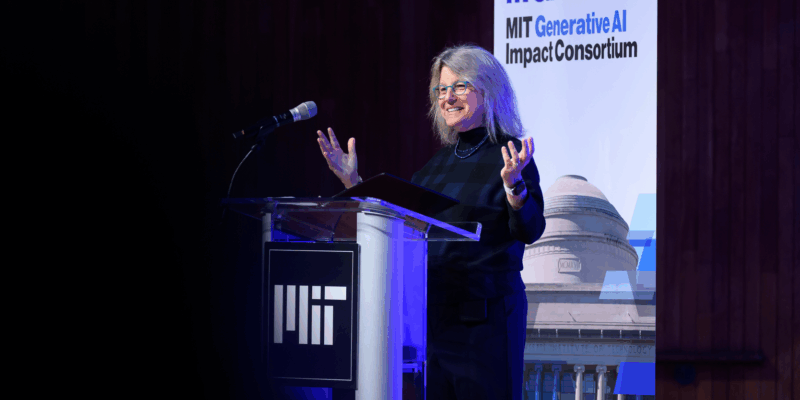
As we ponder the future landscape of AI, thought leaders worldwide converged at MIT’s Kresge Auditorium on September 17. Researchers, executives, educators and students came together for the inaugural MIT Generative AI Impact Consortium (MGAIC) Symposium. It served as a significant touchpoint in MIT’s ongoing initiative to guide generative AI towards meaningful, ethical, and high-impact uses.
Moving into this new era, MIT Provost Anantha Chandrakasan described it as a pivotal moment, noting the rapid pace at which generative AI is advancing. The MGAIC, established earlier in the year, aims to bridge the gap between industry leaders and MIT researchers. The goal? To make sure AI is utilized for the greater public good.
Fostering Innovation while Nurturing Responsibility
This sentiment was echoed by MIT President Sally Kornbluth. She highlighted academia’s role in bringing about responsible progress in AI. As Kornbluth put it, part of MIT’s mission is to ensure the relentless march of such advances on a global scale. But the question remains: How can we tame the magic of generative AI to guarantee its faithful application in real-world, critical scenarios?
Change and exploration in AI won’t just be about scaling up models like GPT or Claude, according to Yann LeCun, Meta’s Chief AI Scientist. Instead, he sees the future in the form of “world models”—AI systems that learn by perceiving and interacting with their environment, much like a child does. “A 4-year-old has seen as much data through vision as the largest LLM,” he pointed out. His foresight posits these world models as crucial for future AI systems, especially in robotics, enabling them to potentially learn new tasks without any prior training and adapting swiftly.
LeCun’s optimism parallels his lack of worry about AI spiraling out of human control. He emphasized the dire need for robust guardrails, akin to societal norms guiding human actions. “By construction, the system will not be able to escape those guardrails,” he reassured the audience.
AI has traversed the barriers of labs and computer screens, embedding itself into tangible entities as well. Tye Brady, Chief Technologist at Amazon Robotics, revealed that generative AI is already boosting efficiency in Amazon warehouses. Brady foresees a future where robots and humans work side by side, enhancing productivity.
Onward and Upward
Panels throughout the day revolved around the Industrial transformation brought about by generative AI. Businesses ranging from Coca-Cola to ambitious startups are taking advantage of AI to innovate and tackle complex issues. Cutting-edge research projects showcased by MIT faculty included noise reduction in ecological data, battling bias in AI systems, and escalating the visual learning abilities of large language models.
The concluding note of the event came from Vivek Farias, MGAIC faculty co-lead and professor at MIT Sloan. His hope for the attendees was a newfound sense of possibility along with an urgency to make that potential a reality. “The future of generative AI is still unfolding. It’s events like the MGAIC Symposium that guide its journey through knowledge, teamwork, and a collective commitment to societal advantage.”


