

 By
By AI Agents: Revolutionizing the Game with Better Questions
In 2026, the world is buzzing with excitement about the capabilities of artificial intelligence agents. These somewhat self-reliant programs can ‘think’ and carry out particular tasks, adding huge value to areas like customer service and software development by using language models (LMs). It’s fascinating, really. Yet, when we consider more significant, uncertain environments that require thorough analysis, such as medical diagnosis and scientific discovery, those LMs fall a little short.
Challenging the AI Boundaries
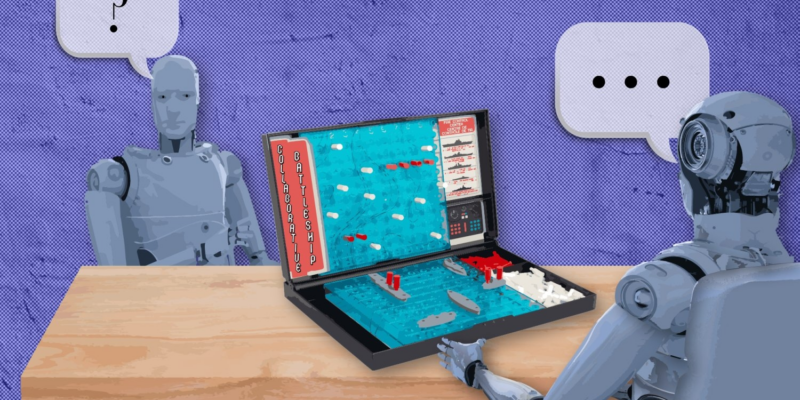
Here’s the exciting part, though. Researchers from MIT’s Computer Science and Artificial Intelligence Laboratory (CSAIL) and Harvard University’s School of Engineering and Applied Sciences (SEAS) are stepping up to tackle these limitations head-on. Their approach? Use the game ‘Battleship,’ a classic childhood favorite that cognitive scientists have used to study human information-seeking behavior and design a new version of it. In their inventive adaptation, ‘Collaborative Battleship,’ one player acts as the ‘captain,’ asking questions about where the hidden ships might be, and the other player — the ‘spotter’— responds in real time.
This study isn’t just about playing games, though. By inviting more than 40 humans to participate, the research team gathered a wealth of questions and answers — the ‘BattleshipQA’ dataset. This rich source of data played a crucial role when it came to evaluating the performance of top LMs like GPT-5 and smaller models like Llama 4 Scout. Interestingly, even before receiving any training, top LMs managed to finish the game quicker than human players, while the smaller systems seemed to have a little more trouble.
Leveling Up Language Models
Researchers observed the main hurdle was the models’ struggle to generate useful questions. To overcome this, they equipped each model with a Monte Carlo inference strategy, empowering them to judge the probability of different scenarios as the game progressed. As a result, even smaller AI models could outwit human players in a game of ‘Battleship.’
The proof? Llama 4 Scout, one of the smaller LMs, boosted its win rate from a mere 8 percent to a rather impressive 82 percent following the strategy refinement. And as the cherry on top, it managed to surpass GPT-5’s performance while costing only 1 percent of the price. It didn’t stop there. While GPT-5 proved its mettle as a spotter, the smaller systems frequently made incorrect guesses about ship locations. The team addressed this speedbump by transforming questions into code, instructing models on how to verify their responses, improving average accuracy by 15 percent.
The effort didn’t just stop at ‘Battleship.’ The researchers also tested the improved LMs in another classic game, ‘Guess Who?’. In both small and large models, they were able to gradually dismiss options to identify hidden characters. Llama 4 Scout went from identifying the character accurately 30 percent of the time to a remarkable 72 percent success rate.
Navigating Uncertainty
Despite the promising progress, it’s not all smooth sailing. Language models still struggle to answer complex questions compared to us humans. As noted by OpenAI researcher and coauthor Valerio Pepe, GPT-5 can defeat an average ‘Battleship’ player but still has some way to go when up against an expert. Nevertheless, these findings highlight the unexplored potential of AI agents and the role they could play in science and research. While ‘Collaborative Battleship’ operates in a relatively straightforward setting, the researchers aim to venture into more complex situations requiring detailed examination.
In the future, the team will study how well humans and AI models work together. Perhaps fine-tuning models on game simulations and throwing more computing power into the mix could enhance predictive powers of LMs, making them even more formidable. Robert Hawkins, an assistant professor of linguistics at Stanford University, pinpoints the real challenge — ‘As AI systems become more agentic, the hardest problems turn out to be social ones.’
This groundbreaking study by MIT’s Gabriel Grand and Valerio Pepe, along with their colleagues Jacob Andreas and Joshua Tenenbaum, is shedding light on how we can teach AI to ask better questions, thus paving the way for future advancements. For more insights on their intriguing work, check out the original news article here.
If your company is exploring AI automation solutions, implementi.ai could revolutionize your operations with state-of-the-art AI technology. Reach out to us today and let’s discuss the possibilities!


