

 By
By Exploring the Societal Impacts of AI at MIT’s AI and Society Forum
Recently, the AI and Society Forum at MIT brought together experts from various disciplines to delve into the intriguing discourse around technological innovation and its implications. Spanning important areas such as labor, work dynamics, civic debate, elections, and more, the event presented a fascinating amalgam of individual studies, thought-provoking discussions, and even a captivating musical performance showcasing the incredible synergy of generative AI and arts.
A Closer Look at the Meet
Set up in partnership by the School of Humanities, Arts, and Social Sciences (SHASS) and the Social and Ethical Responsibilities of Computing (SERC), the forum benefited from collaborations with MIT’s strategic initiatives, the MIT Generative AI Impact Consortium (MGAIC), and the MIT Human Insight Collaborative (MITHIC).
The opening remarks were delivered by Agustín Rayo, the Kenan Sahin Dean of SHASS, and Dan Huttenlocher, dean of the MIT Schwarzman College of Computing. Both emphasized the need for interdisciplinary collaboration to fully understand the societal impact of AI, underscoring that MIT’s mission extends to harnessing technological leadership for positive societal change.
Fresh Insights into Jobs, Democracy, and AI
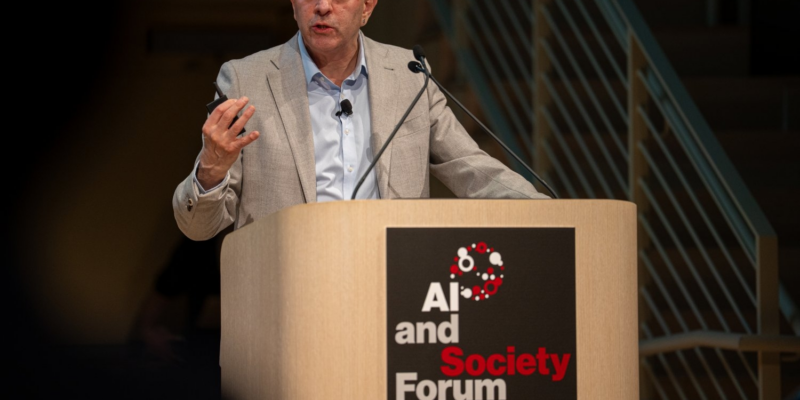
The forum, hosted in the beautiful ambiance of the Tull Concert Hall in MIT’s Linde Music Building, commenced with an enlightening keynote speech by economist David Autor. Rejecting the narrative that AI is a job terminator, Autor instead projected how the influence of technology on job markets hinges on its repercussions on the scarcity and value of human skills. He made a compelling case for AI’s capacity to generate new, specialized work roles while suggesting proactive policies for worker training, wage assurance, and broader asset ownership.
These musings were followed by a stimulating panel dialogue, steered by Rob Loughlin from McKinsey & Company, featuring a cadre of MIT’s brightest minds. The prevalent excitement about AI augmenting workplaces was tempered by calls for continued reliance on human judgement in decision-making. The panel members also reinforced the need for future job creation, development of appropriate skillsets among youth, distinguishing between productivity enhancements and long-term growth impelled by AI, and reckoning with AI’s diverse impact on the workforce.
The conversation then transitioned towards exploring the conjunction of AI technologies and democracy. Chara Podimata surfaced anxieties around the potential bias in election data, resulting from auditing large language models. Scrutiny of multiple models during the 2024 U.S. presidential election unearthed significant variations in responses based on demographics and political affiliations.
Subsequent discussions orchestrated by Songyee Yoon underscored AI’s dual-edged sword-imbued with the potential to undermine democratic norms on one end, and open up new avenues for positive change on the other. Cautionary notes against deploying AI for hastening decision-making and concerns about AI-induced election chaos were balanced with optimism for AI’s ability to reinforce democratic values and contribute to discourse moderation through novel inventions, like a “Socratic dialogue chatbot”.
Interested to uncover what AI automation can do for your business? Venture into the unexplored with implementi.ai and elevate your business operations. For a deeper delve into the forum, visit the original article.


