

 By
By MIT Engineers Develop Agile Flying Microrobots That Mimic Insect Flight
Imagine a future where tiny, insect-inspired flying robots handle disaster scenarios like earthquakes, darting through debris and navigating spaces where larger drones or machines can’t reach. Given their size and agility, these microrobots could perform real-time maneuvering to dodge falling rubble. While the notion may feel like science fiction, advancements from MIT are bringing us steps closer to turning it into reality.
Turning Fiction into Reality
Up until recently, the speed and maneuverability of these microrobots couldn’t quite compete with real insects. They could fly but lacked the agility needed in a dynamic environment. But all that is now changing. Engineers at MIT have developed an AI-based control system that significantly enhances the performance of these mini flyers. It’s a commendable breakthrough in that the robots can now execute rapid, complex maneuvers and exhibit bug-like aerial acrobatics, such as 10 somersaults in as short as 11 seconds.
AI-powered Flight
A novel two-part control scheme is the secret behind this accomplishment. It expertly balances high performance with computational efficiency, increasing the robots’ speed by a whopping 450% and their acceleration by 250%. Associate professor in MIT’s Department of Electrical Engineering and Computer Science, Kevin Chen, visualizes their robots navigating areas traditional quadcopters have trouble flying into, just like bugs.
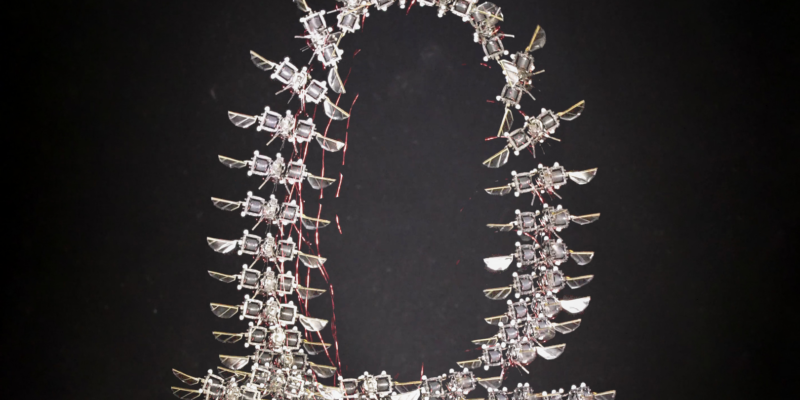
For over five years, Chen’s lab has been developing robotic insects roughly the size of a microcassette and lighter than a paperclip. The robots are powered by soft, artificial muscles that flap their wings at incredible speeds. Yet, the bot’s “brain” or controller was manually tuned by engineers, thereby limiting its responsiveness and agility. To overcome this, the team designed an AI-driven controller in collaboration with Professor Jonathan P. How and his lab. The two-step approach that resulted includes a powerful model-predictive controller to plan complex flight paths, and a deep learning policy trained by imitation, used to execute those plans in real time.
The Road Ahead
The amalgamation of hardware advancements and improved control algorithms have gifted the robot with the ability to perform agile maneuvers with remarkable precision. In tests, it executed 10 continuous flips while adhering to just 4 to 5 centimeters of its intended trajectory, even under wind gusts and complications of a power tether wrapping around it mid-flight. The team has marked their achievement as a stepping stone towards future insect-sized robots with biological counterpart-like agility.
Not only this, but their study also saw a replication of a flight behavior known as “saccade movement” observed in insects. It rapidly pitches and decelerates to localize and stabilize vision – a functionality that could aid in equipping microrobots with onboard cameras and sensors for outdoor, autonomous navigation. Chen shares his excitement about exploring how onboard sensing could support collision avoidance and coordinated navigation among multiple bots.
The researchers foresee the integration of similar capabilities onboard the robot itself in future iterations, even with limited computational resources. For the microrobotics community, this could mean a major leap towards fully autonomous, insect-scale flying robots.
Industry experts already see the potential in this research. Sarah Bergbreiter, a professor of mechanical engineering at Carnegie Mellon unrelated to the study, lauded it as a pointer to future insect-scale robots with agility matching their biological counterparts. It’s only a matter of time before we witness the realization of this science fiction-inspired technology emancipating and making huge strides in our world.
This groundbreaking research received support from the National Science Foundation, the Office of Naval Research, the Air Force Office of Scientific Research, MathWorks, and the Zakhartchenko Fellowship. For more information about this remarkable breakthrough, check out the original news release.


