

 By
By Revolutionizing Drug Development: How OpenProtein.AI is Bridging the Gap Between AI and Biology
Human ingenuity has always helped us master new realms, pushing boundaries and defying the impossible. Today, artificial intelligence (AI) represents one such bold frontier, particularly in the field of drug development and disease understanding. Despite the buzz and excitement around these advancements, the real journey begins when we transform such AI capabilities into tangible, life-saving treatments. The key factor here is arming researchers with the latest, most agile AI models.
However, a common challenge lurks here – not every scientist is an expert in machine learning, which can result in potential obstacles. So, who can lend a hand? The answer comes in the form of OpenProtein.AI, a service committed to empowering researchers and scientists in ways never thought of before.
OpenProtein.AI: A New Dawn in Scientific Research
The magic of OpenProtein.AI lies in their unique approach – providing a no-code platform that allows even those with zero technical nous to harness the power of AI. The inclusive platform garners a stronghold of robust foundation models and a diverse set of tools extending towards protein design, structure, function prediction, and model training.
The brainchild of Tristan Bepler PhD ’20 and Tim Lu PhD ’07, a former associate professor at MIT, OpenProtein.AI’s penetration into the pharmaceutical and biotech sectors is already seen as significant. It’s not just big businesses who are benefitting – their user-friendly platforms are available to firms of all sizes, with academic scientists getting completely free access.
Bepler’s academic journey at MIT turned out to be a revelation – drawing attention to the vast gaps in our understanding of biomolecules and proteins. As a consequence, his research centered on predicting amino acid chains in proteins, guided by analyzing evolutionary data. The result? One of the pioneers in generative AI models for protein design.
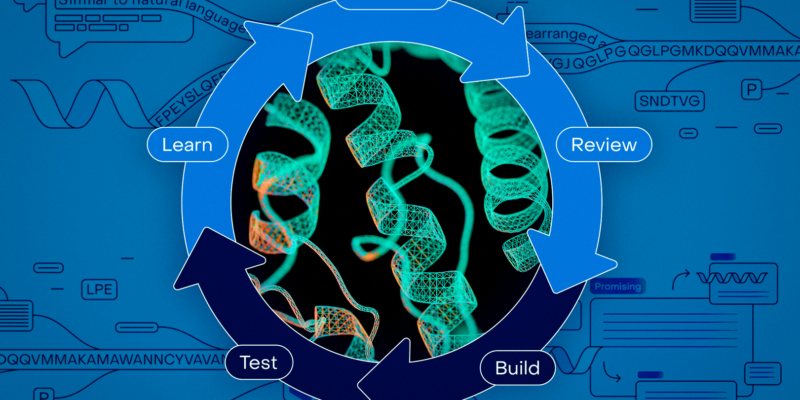
This work directly led to the inception of OpenProtein’s flagship protein language model, PoET. This advanced model can comprehend and apply evolutionary constraints on proteins. Additionally, the PoET model allows for the integration of researchers’ experimental data, evolving continually without the need for retraining. OpenProtein’s intuitive interface enables biologists to upload their own data, harnessing the power of AI without the need for coding skills.
Breadth and Depth: OpenProtein’s Adaptive Nature
Flexibility is key in innovation and OpenProtein’s platform is exactly that – a versatile toolbox supporting an extensive array of protein functions and classes. This adaptability ensures the creation of efficient protein designs, accelerating lab testing processes by identifying promising candidates expeditiously. The ingenuity of the platform extends to its open-ended design, ensuring adaptability to diverse research needs.
The successful potential of OpenProtein’s platform is proven not just by fraction of satisfied academic users, but by industry giants like pharmaceutical company, Boehringer Ingelheim. In 2025, they turned to OpenProtein to engineer proteins for disease treatment, such as cancer and autoimmune disorders. Taking a leap into the future, OpenProtein’s latest model, PoET-2, despite using less resources, outflanks larger models and positions the company at the forefront of innovation.
OpenProtein’s Mission: Fostering Innovation and Accessibility
While the future of AI stands at the heart of OpenProtein’s mission, the dynamic nature of protein function is equally acknowledged by the company. This balance ensures the development of intricate therapies, stoking a new wave of treatments for ailments.
Co-founder Tim Lu recognizes the significance of maintaining open AI ecosystems, citing concerns of AI resource concentration potentially thwarting scientific advancements. Dedication to this mission has kept OpenProtein’s tools accessible, allowing the field of biology to continue to innovate.
Is your company in need of AI automation? Then consider exploring the horizon with implementi.ai. You can find more details by visiting the original news article.


